

The Strange Kitchen Tool That Left the Internet Searching for Answers
In today’s world, it only takes one unusual photo to spark a massive online debate. Every day, people discover mysterious objects in old garages, antique stores, attics, and family storage boxes, then turn to the internet hoping someone can identify them.
More often than not, what appears baffling at first turns out to have a surprisingly practical purpose.
One such object has repeatedly puzzled social media users: a heavy metal device that clamps onto a table and features a rotating handle. Its industrial appearance has led many people to guess everything from a woodworking tool to a machine part. But internet detectives are usually quick to recognize it.
The mystery item is actually a meat mincer — also known as a meat grinder — a kitchen tool that has been helping people prepare food for generations.
A Simple Tool With an Important Job
A meat mincer is designed to break meat down into small, uniform pieces. Traditional models feature a sturdy metal body, a crank handle, an internal screw mechanism, and a perforated plate through which the meat is forced.
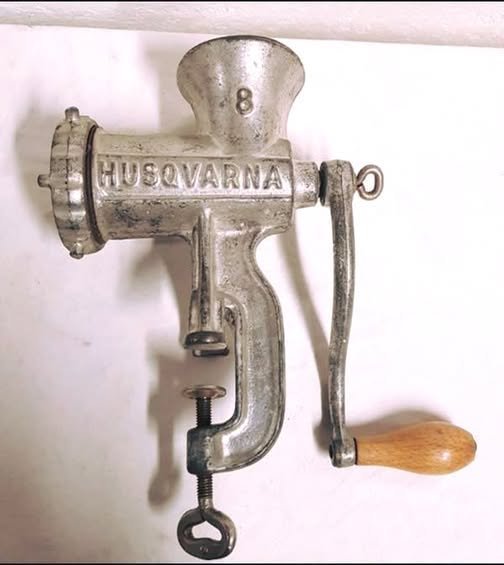
To use it, meat is placed into the top opening while the handle is turned by hand. Inside the device, a rotating screw pushes the meat toward a blade that chops it before pressing it through small holes, creating the familiar minced texture used in countless recipes.
Though simple in design, the tool revolutionized home food preparation by making it easier to process meat quickly and consistently.
A Kitchen Staple From Another Era
Long before modern electric appliances became common, manual meat mincers were found in homes, butcher shops, and restaurants around the world. Most early models were made from cast iron or steel and were securely attached to countertops using clamps.
The invention dates back to the 19th century, a period marked by rapid industrial innovation and the creation of many labor-saving household devices. These grinders offered families a practical way to prepare fresh meat at home while maintaining control over quality and freshness.
As their popularity grew, manufacturers improved the designs, making them stronger, cleaner, and easier to use.
How the Mechanism Works
The operation of a manual meat grinder is remarkably straightforward.
Once meat is placed into the feeding chamber, turning the handle rotates a screw-like auger inside the machine. This auger moves the meat toward a sharp cutting blade. The blade slices the meat while pressure forces it through a metal plate containing small holes.
Different plates can produce finer or coarser grinds depending on the desired texture.
The beauty of the design lies in its simplicity. No electricity is required, and the mechanism is durable enough to function reliably for decades.
The Rise of Electric Models
As electricity became widely available in homes during the 20th century, manual grinding gradually gave way to electric versions.
Electric meat grinders use the same basic process but replace manual effort with a motor. This allows users to process much larger quantities of meat in far less time.
Modern grinders often include attachments for making sausages, preparing vegetables, and handling a variety of specialty foods. Many feature multiple speed settings, improved safety systems, and easy-to-clean stainless-steel components.
Today, electric meat grinders remain popular in both home kitchens and commercial food production facilities.
Why It Was Such a Valuable Invention
Before meat grinders existed, preparing minced meat often meant spending significant time chopping by hand with knives.
The meat mincer dramatically simplified this process. Families could prepare fresh ingredients more efficiently, while butchers could serve customers faster and more consistently.
The invention also helped popularize many beloved foods, including meatballs, sausages, burgers, stuffed vegetables, and numerous traditional dishes found across cultures.
Why It Confuses People Today
Many younger generations have never encountered a manual meat grinder. Because electric appliances have largely replaced them, these older devices are often viewed as strange relics from the past.
Their heavy metal construction, exposed mechanical parts, and industrial appearance can make them look more like workshop equipment than kitchen tools.
As a result, whenever one appears in an online photo, people often struggle to identify it—until someone familiar with its history steps in to explain.
The Internet Solves Another Mystery
One of the most fascinating aspects of modern social media is how quickly communities come together to solve puzzles like this.
A single image of an unfamiliar object can attract hundreds of comments from people sharing memories, expertise, and historical knowledge. Within hours, a mystery that once seemed unsolvable often has a clear answer.
The humble meat mincer is a perfect example. What initially appears to be an odd and confusing device is actually a clever invention that played a major role in the evolution of home cooking.
From its hand-cranked beginnings to today’s powerful electric versions, the meat grinder remains a testament to practical design and human ingenuity. And thanks to the internet, its story continues to educate and surprise new generations whenever one of these old tools resurfaces.


