

The steady beeping of hospital machines echoed through the room as six-month-old Lucas lay motionless in his crib. Every sound felt heavier to his mother, Sarah, who had spent countless sleepless nights sitting beside him, holding his tiny hand and praying for even the smallest sign of improvement. What once sounded like ordinary medical equipment had become painful reminders of how fragile her son’s condition truly was.
Doctors had warned Sarah from the beginning that Lucas was critically ill. Despite constant monitoring and advanced treatment, his condition continued to worsen. Eventually, the medical team delivered the heartbreaking news she feared most — they were running out of options. Continuing aggressive treatment, they explained, might no longer make a difference.
But Sarah refused to give up hope.
She remained by Lucas’s side every moment she could, convinced that her presence still mattered. As long as her baby continued fighting for his life, she promised herself she would fight with him. That bond between mother and child became stronger than every difficult conversation happening around her.
Back at home, someone else seemed deeply affected by Lucas’s absence — Rex, the family’s loyal German Shepherd. Since Lucas was born, Rex had rarely left the baby’s side. He would rest beside the crib for hours and react immediately whenever Lucas cried or became uncomfortable. To Sarah, their connection felt unusually deep, almost instinctive.
When Lucas was admitted to the hospital, Rex was forced to stay behind because of hospital rules. Almost immediately, his behavior changed. He paced constantly through the house, waited near doors, and reacted anxiously whenever he heard sounds connected to Lucas. It was as though he sensed something was terribly wrong.
As Lucas’s condition became more critical, Sarah grew convinced that seeing Rex might comfort her son in ways medicine could not. But hospital policy strictly prohibited animals inside intensive care areas. No matter how many times she pleaded, her request was denied.
Desperate for one final moment of comfort, Sarah eventually found support from a compassionate nurse who understood her pain. Quietly, and without official approval, arrangements were made to bring Rex into the hospital room.
But the moment Rex entered, something unexpected happened.
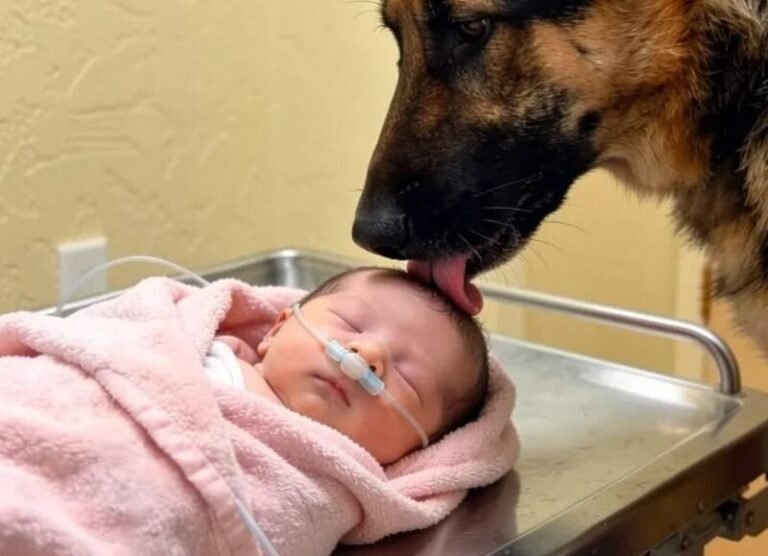
Instead of calmly approaching Lucas, the German Shepherd froze. His body stiffened as he slowly scanned the room. He circled carefully, focusing not on the baby, but on the equipment surrounding him. His attention locked onto a section near the feeding supplies and the wall beside Lucas’s crib.
The emotional reunion instantly turned tense.
Rex began scratching near the equipment and staring intensely at one specific area. His handler immediately realized this was not normal behavior. Trained German Shepherds often react to danger or environmental abnormalities long before humans notice them, and Rex appeared deeply alarmed.
Moments later, hospital staff rushed into the room after discovering the unauthorized animal. But before anyone could remove Rex, the situation suddenly escalated. Lights flickered overhead. Machines briefly alarmed. Then a faint burning smell filled the air.
Technicians were called immediately.
After inspecting the room, they discovered overheating electrical wiring hidden behind the wall near Lucas’s crib — a serious malfunction that could have triggered a dangerous fire throughout the pediatric unit if left unnoticed.
Suddenly, Rex’s behavior made perfect sense.
As staff investigated further, another disturbing issue surfaced. Certain feeding supplies stored in the unit showed signs of possible contamination, prompting an urgent safety review. Medical teams quickly removed the affected materials and reassessed treatment procedures for vulnerable patients, including Lucas.
Lucas was transferred to a safer area while doctors adjusted his care plan. For Sarah, the emotional weight of the day became almost impossible to process. Only hours earlier, she had been preparing herself for the possibility of losing her son. Now, hidden dangers inside the hospital itself were being uncovered one after another.
Then something remarkable happened.
Over the next several hours, Lucas began showing small but encouraging signs of improvement. Doctors remained cautious, but the changes were enough to continue treatment with renewed hope. For Sarah, every tiny sign of recovery felt like a miracle.
The hospital later launched a full investigation into both the electrical failure and the possible contamination concerns. Safety procedures, maintenance oversight, and supply management all came under intense review.
But among hospital staff, one topic kept resurfacing — Rex.
Many who initially viewed his presence as a violation of policy now believed his instincts had helped expose serious dangers before tragedy could strike. His unusual behavior had drawn attention to problems no one else had detected in time.
For Sarah, the experience changed her forever. Rex was no longer simply a beloved pet. In her eyes, he had become part of her son’s survival story — a loyal protector whose instincts may have saved lives.
In the days that followed, Lucas continued slowly recovering under close medical supervision. Repairs were completed, safety measures strengthened, and the hospital gradually returned to normal. But for Sarah, nothing would ever feel ordinary again.
What stayed with her most was the realization that sometimes warnings come from the most unexpected places. In a room filled with doctors, machines, and advanced medical systems, it was the instinct of a devoted German Shepherd that helped uncover dangers hidden in plain sight.


