

Airports carry a restless energy—never silent, never still—only shifting from one urgency to the next as minutes blur into hours. Departure boards glow and change without pause. Rolling suitcases murmur across polished floors. Overhead announcements promise calm that rarely matches the tension below.
Near Gate C17, a small café lived inside that constant motion. Steam shrieked from espresso machines. Travelers checked phones, watches, and doors in endless rotation. Everyone seemed busy. No one truly saw anyone else.
At a quiet table against the wall sat Lucas Reed.
He had chosen the seat with care. From there, he could watch the entrance, the hallway toward security, and the corner where anxious passengers often stalled—yet appear to be watching nothing at all. In his early fifties, Lucas still carried the quiet precision of military life in the way he held himself: straight-backed but relaxed, alert without seeming tense.
He had once been a Navy SEAL.
Years had passed since the uniform, the missions, the danger—but not the instincts. He still noticed who avoided eye contact, who scanned exits too often, who moved against the natural rhythm of a room. Real trouble, he knew, rarely arrived loudly. It slipped in disguised as ordinary.
At his feet rested Shadow.
The aging Belgian Malinois looked, to strangers, like a retired service dog enjoying sleep. Lucas knew better. Shadow was never fully at rest. His ears shifted with subtle sounds. His breathing stayed measured. His half-closed eyes were not dreaming—they were watching.
For most of his life, Shadow had worked beside soldiers, trained to detect explosives, hidden weapons, and the faint behavioral signals that precede violence. Retirement hadn’t erased that training. He still observed first… and acted without hesitation when needed.
Lucas sipped his coffee slowly, more for routine than taste, scanning the café in reflections along the window rather than direct stares. A couple argued in whispers. A businessman jabbed at his phone. A woman checked the door, then her watch, then the door again.
Shadow’s ears twitched once.
Lucas didn’t move.
Not yet.
Because the world, he had learned, rarely changes in explosions.
It changes in moments small enough to miss—unless you know how to look.
Somewhere inside the rhythm of Gate C17, something was about to shift.
Shadow’s head lifted.
The motion was slight, almost invisible—muscles tightening beneath fur, attention sharpening toward movement rather than sound. Lucas followed the dog’s gaze until he saw her.
The girl looked ten, maybe eleven. Hard to tell. Some children carry worry the way others carry backpacks, aging them too quickly. She moved slowly between tables, favoring one leg bound in an orthopedic brace clearly too small. The worn straps pressed into irritated skin. What had once been white had faded into dull gray from long overuse. Every step looked calculated.
Her clothes were clean but thin. Chosen to appear acceptable, not comfortable.
She held a paper cup in both hands as if afraid it might disappear.
But her eyes were what stopped him.
They didn’t search with curiosity.
They scanned with caution.
Around her, people looked away. Some pretended not to see. Others refused silently before she could speak. A few pulled bags closer, fear outrunning logic. With every rejection, her shoulders curled inward—until she reached Lucas’s table.
She hesitated.
“Sir… may I sit here for a minute?”
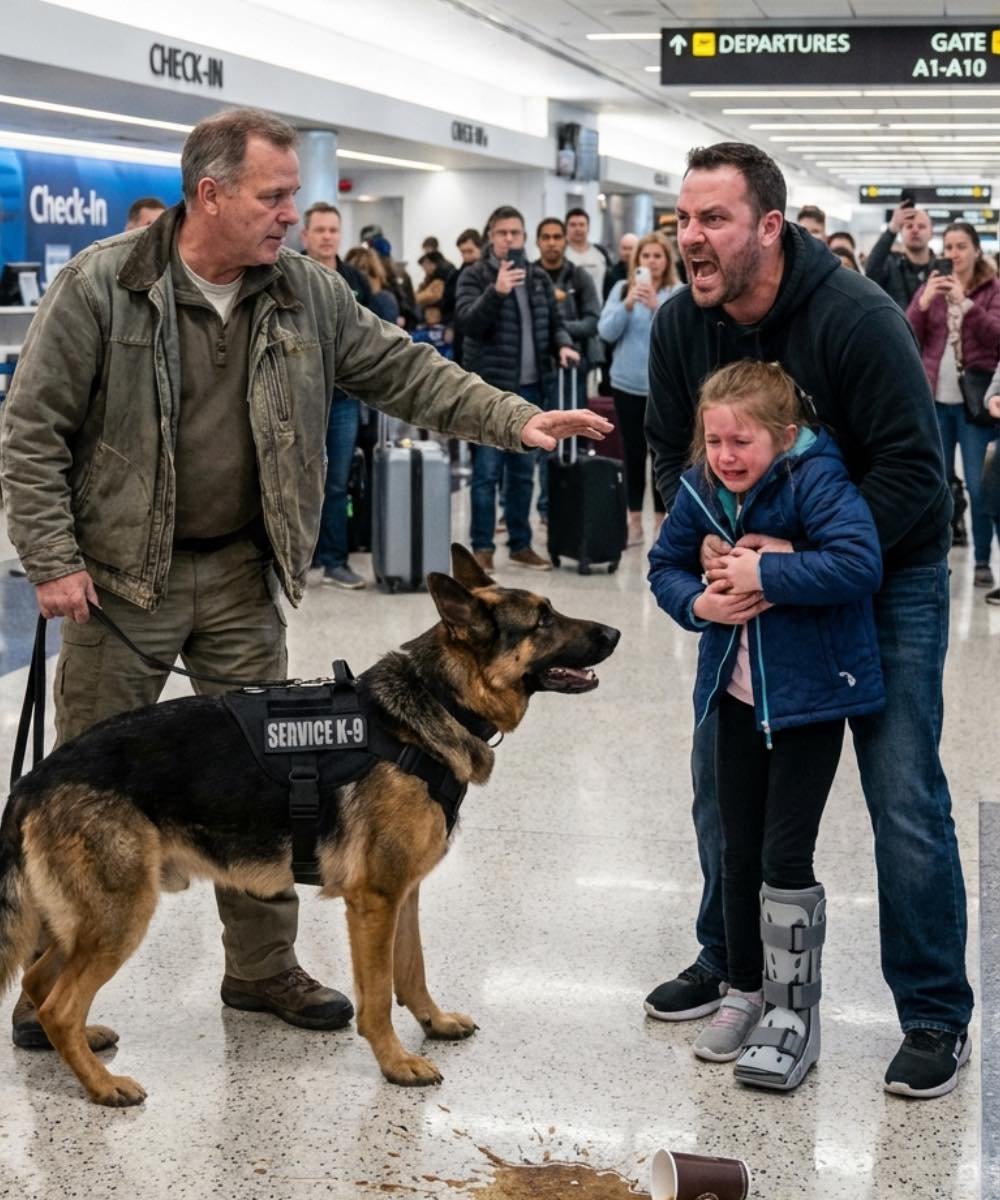
Before Lucas could answer, Shadow stood.
Not aggressive. Not loud.
Just suddenly certain.
His focus wasn’t on the girl—it was fixed beyond her, toward the café entrance.
Lucas rested a calming hand on the dog’s shoulder.
“It’s okay,” he said softly. Then to the girl:
“Yes. You can sit.”
Relief flickered across her face before she carefully lowered herself into the chair, wincing as the brace shifted. When her sleeve moved, Lucas saw bruises along her arm—fading yellow layered over newer marks. Not accidents. Fingers.
“My name is Lena,” she said quietly.
“I’m Lucas,” he replied gently. “Are you flying somewhere?”
She tightened her grip on the cup.
“I don’t know… I left.”
Two small words. Heavy as truth.
She spoke in fragments after that.
Her mother gone three years.
A man named Eric Caldwell moving in, calling himself a caretaker.
Rules turning into control.
Food into leverage.
Pain into punishment.
The brace never replaced as she grew.
“If I told anyone,” she whispered, “he said I’d never run again.”
A shadow fell across the table.
“There you are,” a man snapped, grabbing her arm.
“What did I tell you about wandering off?”
Lena recoiled.
Shadow’s bark split the café silence.
Lucas stood—calm, immediate, certain—placing himself between them.
“Take your hand off her,” he said evenly.
“Right now.”
The man sneered. “Mind your business. She’s my kid.”
Lena clutched Lucas’s sleeve, trembling.
Shadow stepped forward, silent and ready.
“Step back,” Lucas said. “Security is coming.”
Mocking laughter—thin with doubt.
“You think a dog scares me?”
Lucas shifted so the bruises showed clearly in the light.
“She’s not leaving with you.”
Then the man hissed a threat meant only for her—
but phones were already recording.
Airport police arrived within moments.
Lena’s quiet words ended everything:
“He’s lying. He’s not my father.”
Cameras, witnesses, medical reports—truth with nowhere left to hide.
Eric Caldwell was arrested that afternoon on felony charges.
Lena left wrapped in a blanket, her injured leg finally treated with care instead of neglect. Shadow pressed his head into her hand once before she was taken away.
A silent promise.
Healing came slowly.
A brace that fit.
Food that stayed.
Therapy.
Safety.
Lucas visited when allowed. Never pushing. Never claiming credit.
Shadow lay beside her during reading sessions, tail tapping softly against the floor.
One day she asked,
“Why did you help me?”
Lucas took a moment.
“Because once,” he said quietly,
“I looked away when I shouldn’t have.
I won’t do that again.”
Years later, Lena stood on a small stage telling her story—
to social workers, foster families, children who understood every word.
In the back of the room stood Lucas.
Shadow beside him.
No spotlight. No applause sought.
Just proof that a single moment of courage can change the direction of a life.
The truth is simple:
Real heroism is often quiet.
Sometimes it is nothing more than noticing…
and refusing to look away.


