

The cold, open waters near the Farallon Islands off the coast of San Francisco are both breathtaking and unforgiving. Powerful currents, low temperatures, and rich marine life define the region—and demand respect from anyone who enters it.
It was here that professional diver James Moskito was working with a small group of volunteers on routine ocean conservation and safety efforts. None of them imagined that the day would turn into a rescue that would captivate millions around the world.
The moment everything changed was quiet and easy to miss.
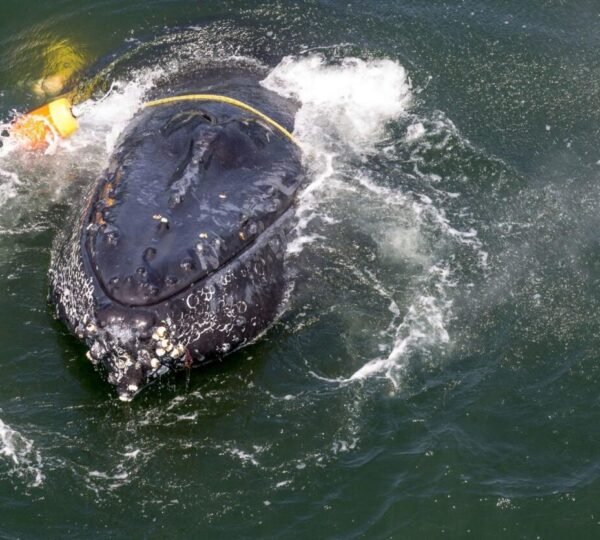
While scanning the water’s surface, James noticed a humpback whale lingering far longer than normal. Humpbacks typically surface briefly to breathe before diving again, sometimes remaining underwater for long stretches. This whale didn’t.
It stayed nearly motionless. One eye remained above the waterline, fixed on James.
Years of experience told him something was wrong. This wasn’t curiosity or coincidence—it was distress. The whale looked exhausted, uncomfortable, and frightened.
“I could tell it was looking at me,” James later said. “It felt like it was waiting.”
Trusting that instinct, James made a decision that required calm, courage, and complete focus. He entered the water and began swimming slowly toward the massive animal, fully aware of the danger.
An adult humpback can weigh up to 40 tons. One sudden movement could be fatal. Still, James moved carefully, keeping his motions slow and non-threatening.
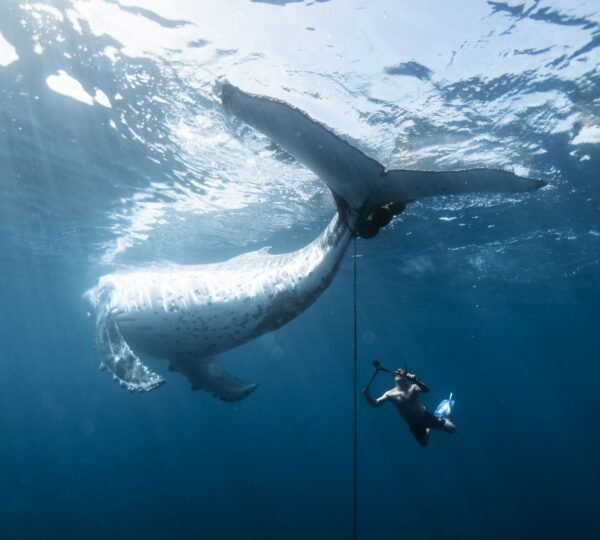
As he drew closer, the scale of the whale was overwhelming—its vast body just beneath the surface, marked by scars from long migrations and countless encounters with the hazards of the sea.
James gently placed a hand near the whale’s eye, an area known to convey reassurance. Speaking softly through the water, he said, “I’m here to help you. I won’t hurt you.”
The whale didn’t pull away. It stayed still.
As James swam along its body, the cause of the distress became horrifyingly clear. A massive anchor—estimated to weigh nearly 3,000 pounds—was lodged deep in the whale’s tail. A thick metal chain, stretching close to a mile in length, trailed behind it.
The weight was crushing. Dragging such a load made swimming and diving nearly impossible. Over time, the strain would have led to exhaustion, severe injury, or drowning. The chain itself risked cutting deeper into the whale’s flesh, increasing the likelihood of infection.
Without immediate help, the whale would not survive.
James signaled the rest of the team, and the rescue began.
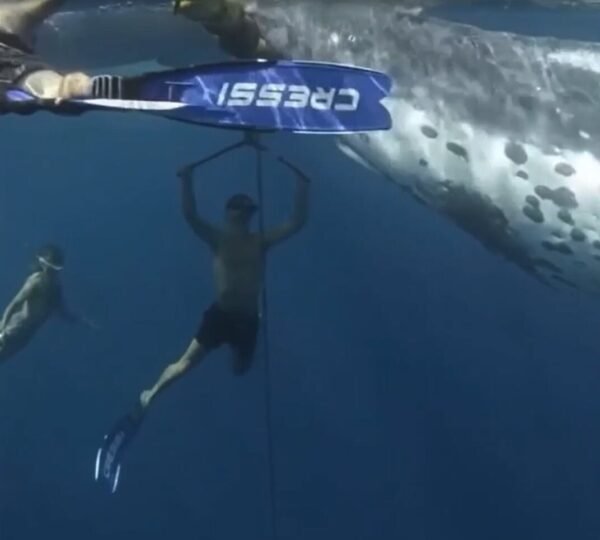
Working in open-ocean conditions meant battling cold water, strong currents, limited visibility, and the unpredictable movement of a distressed wild animal. Every step carried risk.
The divers began cutting away the chain piece by piece. Each link was thick and heavy, requiring strength, precision, and coordination. They took turns, fighting fatigue while staying focused.
Hours passed as the weight slowly lessened.
Throughout it all, the whale remained remarkably calm. It didn’t thrash or try to flee. Instead, it stayed near the surface, allowing the divers to continue.
Many on the team later described the experience as deeply emotional—a rare moment of mutual trust between humans and a wild animal.
Finally, after hours of exhausting effort, the last section of chain was cut free. The massive anchor dropped away, disappearing into the depths below.
The whale was free.
Then something extraordinary happened.
Instead of swimming away, the humpback stayed close to James. It began to circle him slowly, tracing gentle figure-eight patterns in the water. At times, it drifted close enough to lightly brush against him.
To those watching, it felt like acknowledgment.
James later said the moment was unforgettable. While scientists caution against assigning human emotions to animals, the whale’s behavior was unmistakably unusual. There was no fear. No aggression.
Only calm, deliberate presence—before the whale finally swam off to continue its journey.
The rescue drew global attention, not just for its danger, but for what it revealed about whales themselves. Research has shown that whales possess specialized brain cells called spindle neurons, associated with empathy, emotion, and social awareness—cells also found in humans and great apes.
Humpback whales are especially known for their intelligence, complex songs, cooperative feeding, and curiosity toward humans. This encounter added another powerful example to the growing evidence that whales are deeply aware beings.
The incident also highlights a harsh reality. Human debris—anchors, fishing gear, and lost equipment—continues to injure and kill marine animals every year. Large species like whales are especially vulnerable to entanglement, which often leads to slow, painful deaths.
Conservation groups stress that prevention requires better equipment management, increased awareness among boat operators, and continued support for rescue programs.
For James Moskito and the volunteers, the rescue reaffirmed why they dedicate their lives to the ocean. The risks were real, the outcome uncertain—but the reward was witnessing a life saved through patience, skill, and compassion.
Beyond the rescue itself, the story resonates on a deeper level. It shows what’s possible when humans meet the natural world with respect instead of dominance.
In a time when environmental crises can feel overwhelming, this moment offers something tangible: proof that individual action still matters.
Through courage, calm, and empathy, a life was saved—and a connection was made that continues to inspire people around the world to care more deeply for the oceans we share.


