

The infant at the center of one of psychology’s most debated experiments—often described today as an example of medical misogyny and ethical failure—was known only as “Little Albert.”
For decades, his identity remained a mystery, as did the tragic direction his life would later take.
A Theory That Changed Psychology
In the 1890s, Russian neurologist Ivan Pavlov discovered that dogs could learn through associations, responding to a bell as if it were food.
His work inspired the rise of behaviorism, a school of thought claiming that human behavior is shaped not by thoughts or feelings, but by conditioning, rewards, and punishments.
A Baby Becomes an Experiment
John B. Watson, considered the father of behaviorism, was determined to test conditioned fear on a human infant.
In 1920, he and his assistant Rosalie Rayner selected a 9-month-old baby boy from the hospital where the child’s mother worked as a wet nurse.
“He was one of the best-developed infants ever brought to the hospital,” they wrote.
Calm, steady, rarely crying — the perfect subject for an experiment they believed would cause “little harm.”
But the experiment was far from harmless.
At first, Albert showed curiosity toward the soft animals Watson presented—especially a white rat.
But then came the twist:
Every time the baby reached for the rat, Watson struck a steel bar behind him.
A deafening noise.
A startled infant.
A new fear.
Soon, Albert wasn’t just frightened of the rat.
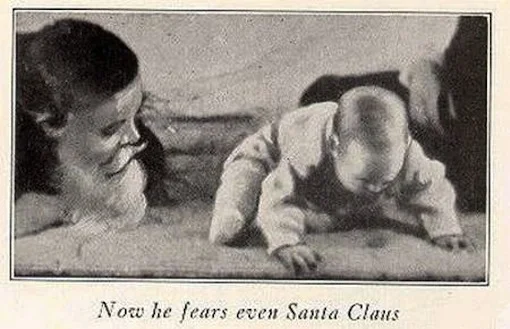
He reacted with distress to anything soft or furry—a rabbit, a dog, even a coat. Watson had successfully conditioned fear.
He claimed this “proved” that human emotions were nothing more than learned reactions.
The Part He Hid
Watson never informed Albert’s mother about the full nature of the experiment.
When she realized what was happening, she removed her baby from the study.
Watson and Rayner promised to undo the conditioning — but they never did.
Little Albert left with fears that were never reversed.
Who Was He Really?
For decades, no one knew the baby’s identity. Watson kept the name hidden.
In 2009, after intensive investigation using facial analysis and hospital records, researchers concluded that Little Albert was almost certainly Douglas Merritte, the son of a hospital worker.
Their discovery brought with it heartbreaking news:
Douglas faced serious medical challenges early in life, including meningitis and developmental complications long before Watson ever placed him in front of a rat.
Footage from the experiment shows no typical social smiles, no seeking comfort from adults, even when frightened — signs of significant neurological difficulties.
“He behaves like a child with profound medical issues,” psychologist Dr. Alan Fridlund explained.
“The clues were there all along.”
A Life Cut Short
Historical records show that Douglas’s life ended tragically early, at only six years old, due to complications from hydrocephalus — a condition where fluid builds up around the brain.
His brief existence was far more fragile than Watson ever revealed.
A Foundation Built on Flawed Ethics
Modern psychologists widely condemn the study:
- An infant used without informed consent
- A mother kept uninformed
- A frightened child given no comfort
- A harmful fear intentionally created and never reversed
- All performed on a baby already struggling with significant health challenges
Today, the Little Albert case is taught not as scientific triumph, but as a warning—a reminder of what happens when ambition outruns humanity.
Dr. Fridlund says it best:
“This story forces us to confront issues of ethics, exploitation, and compassion. Behind the experiment was not a symbol or a theory — but a real child.”
A Legacy That Should Never Be Forgotten
Douglas Merritte — the boy the world knew only as “Little Albert” — was far more than a footnote in psychological history.
He was a child deserving of protection, comfort, and dignity.
His story remains a powerful reminder that science must always value people over theories, and that compassion must guide every step of discovery.


