

I had been an emergency physician at Saint Raphael Medical Center in Milwaukee for nearly eight years—long enough to think I had reached my limit for shock, grief, and disbelief. Long enough to believe that whatever still managed to surprise me couldn’t possibly crack my sense of self or my understanding of the world.
I was wrong in a way that would take years to explain.
It was a Thursday night in early November. No holiday. No storm anyone would remember. Just cold rain tapping against the windows like restless fingers. I was five minutes from the end of my shift, already picturing the quiet of my apartment and the leftovers waiting in my fridge, when the automatic ER doors slammed open so hard the security alarm shrieked.
“What the hell—” someone muttered behind me.
There was no ambulance. No gurney. No shouting paramedics.
Only the sharp, frantic scrape of claws on tile—uneven, urgent, desperate.
“Sir, you can’t bring animals in here!” Frank, our night security guard, shouted as he sprang up from his chair.
I turned, expecting a familiar kind of chaos—maybe a drunk man, maybe a stray dog. Something easy to label and forget.
Instead, my body locked in place.
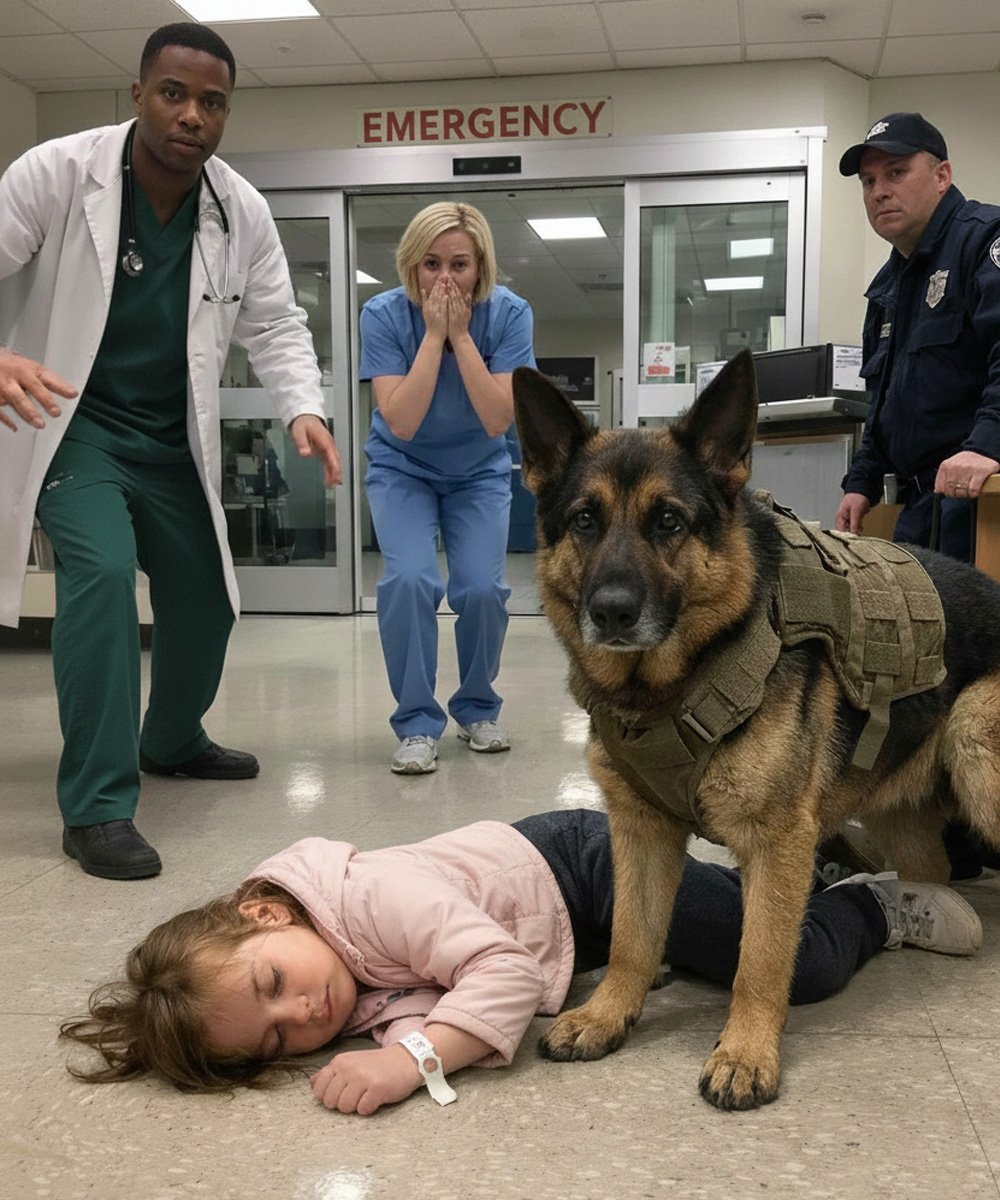
A German Shepherd stood beneath the fluorescent lights. Massive. Soaked through. His ribs heaved with every breath, his eyes wild yet terrifyingly focused. Gently clenched in his jaws was the sleeve of a little girl’s yellow jacket.
The child barely moved.
She couldn’t have been more than six years old. Her head lolled at an unnatural angle as the dog dragged her forward inch by inch, refusing to release her until he reached the center of the waiting room. Only then did he let go—and immediately positioned himself over her small body, standing guard like a living shield.
“Oh my God,” Nurse Allison whispered. “She’s not breathing.”
Frank’s hand hovered between his radio and the taser on his belt. “Doc… that dog looks dangerous.”
“He’s protecting her,” I said, already moving. “Put it away.”
The dog growled—low and steady. Not a threat. A boundary.
I stopped a few feet away and raised my hands, my heart pounding.
“It’s okay,” I said softly, surprised by how steady my voice sounded. “You did good. Let us help her.”
For a long moment, he stared straight at me, as if weighing something deeper than instinct. Then he let out a broken whine—raw, frightened—and stepped aside before collapsing onto the floor.
“Code Blue. Pediatric!” I shouted. “Get a gurney—now!”
We moved fast. The girl was ice-cold, her lips tinged blue, her pulse faint but still present. As we lifted her, the dog forced himself upright despite an obvious limp, staying pressed against the gurney as if afraid we’d disappear.
“You’re bleeding,” Allison said, pointing.
I followed her gaze and felt my stomach drop. Blood soaked his left shoulder, dark against rain-matted fur.
“He stays,” I said when Frank protested. “I don’t care what policy says.”
In Trauma One, the room erupted into motion—IVs snapping into place, monitors screaming numbers no one wanted to see. As I cut away the girl’s jacket, my hands froze.
The bruises were unmistakable. Human. Finger-shaped.
And around her wrist were the remains of a plastic restraint, chewed through with desperate force.
“This wasn’t an accident,” Allison whispered.
“No,” I said quietly. “It wasn’t.”
Moments later, the heart monitor flatlined.
“Starting compressions,” I announced, counting under my breath as sweat dripped and seconds stretched endlessly.
The dog dragged himself closer, resting his head against the bed, whining softly and steadily—like a prayer.
“Epi’s in,” Allison said.
“Come on,” I muttered. “Stay with us.”
Then—against all odds—the monitor beeped.
“She’s back,” someone said, voice breaking.
Relief washed over us, thin and fragile. The room still felt wrong—heavy, charged, like the air before a tornado.
As the girl was rushed to CT, I finally turned my attention to the dog. I cut away his mud-soaked vest and froze.
Kevlar.
Military-grade.
Beneath it, a bullet wound deep enough to make my hands tremble.
“You’re a long way from home, aren’t you?” I murmured.
Near his ear was an embedded chip, and attached to the vest was a metal tag I recognized instantly.
U.S. MILITARY K9 UNIT.
My phone buzzed in my pocket—my wife—but I ignored it as Sergeant Owen Parker stepped into the room, rain still clinging to his uniform.
“Tell me you didn’t just find a restrained child and a military dog in your ER,” he said quietly.
“I wish I could,” I replied. “Do you recognize him?”
Parker swallowed. “That’s Atlas.”
The name landed hard.
“He belongs to a retired Special Forces operator,” Parker continued. “Grant Holloway. Lives near the quarry outside town. He has a daughter.”
My chest tightened. “Her name?”
“Maeve,” Parker said. “Six years old.”
Allison returned moments later, holding a sealed evidence bag.
“We found this in her pocket.”
Inside was a soggy scrap of paper, written in a hurried adult hand:
HE DIDN’T MEAN TO. HE LOST CONTROL.
Silence swallowed the room.
Parker exhaled slowly. “Grant’s been struggling,” he said. “But hurting his own kid…”
The lights flickered.
Once.
Twice.
Then everything went dark.
Emergency lights flooded the hallway in red as Atlas rose, teeth bared, body rigid, staring toward the corridor.
“He’s here,” I whispered.
A calm voice echoed through the darkness. “Doctor, I just want my daughter.”
Parker raised his weapon. “Grant, step into the light.”
“I can’t,” the voice replied softly. “Not after what I’ve done.”
A shadow moved down the hall.
Atlas glanced at me, then toward the CT wing—and I understood exactly what he was about to do.
“Find her,” I whispered.
He ran.
What followed was chaos measured in heartbeats—commands shouted, footsteps retreating—until silence shattered by a single sharp bark. A sound that felt like a verdict.
We found Grant Holloway slumped near CT, his weapon discarded, hands shaking, eyes empty. Atlas stood between him and the scanner door.
“She’s alive,” I said quietly. “Because of you. Both of you.”
Grant collapsed into sobs, repeating her name like a confession.
The investigation that followed was long and painful—but human. Therapy. Advocates. A system that, for once, chose healing over punishment.
Maeve recovered.
Atlas retired, adopted into a quieter life of peanut butter treats and sunlit afternoons.
Grant got help. Real help.
And that night, I learned that sometimes the line between danger and salvation has four legs, muddy paws, and a heart that refuses to quit.


